 An official website of the United States government

Introduction to Blood
On this page...
Blood is a type of circulating connective tissues. Blood is also one of the two types of liquid tissues found in the body. The other being lymph, which is derived from blood. Blood, as a circulating connective tissue differs from other connective tissues in that the cells are not fixed. They freely circulate in a liquid matrix (blood plasma). In an adult human, blood volume measures about five liters and accounts for eight percent (8%) of the body weight.
Blood brings nutrients and oxygen to the cells but also serves as the primary transport medium which carries away metabolic cellular waste in order to maintain a stable cellular environment in the human body. The heart pumps blood through a superhighway of blood vessels to all the organs in the body.
Functional Activities of Blood
| Activity | Description |
|---|---|
| Transport |
|
| Regulation |
|
| Protection |
|
Origin and Production of Blood
As stated previously, the production of blood cells is called hematopoiesis and starts with hematopoietic stem cells. Before birth, hematopoiesis occurs primarily in the liver and spleen of the fetus, but some cells develop in the thymus, lymph nodes, and red bone marrow. After birth, most production is limited to red bone marrow in specific regions, but some white blood cells are produced in the lymphoid tissue. New (immature) blood cells are called blasts. Some blasts stay in the marrow to mature, while others travel to various parts of the body to mature.
Hematopoietic stem cells reside in the bone marrow (femurs, hips, ribs, sternum, and other bones) and have the unique ability to give rise to all the different mature blood cells. They are also self-renewing. Some of the daughter cells remain as unspecialized, undefined or uncommitted hematopoietic stem cells, so the pool of stem cells does not become depleted. This is a unique process to stem cells and is incredibly important to our survival.
All of the formed elements originate from pluripotential cell or hemocytoblasts. From the hemocytoblast, seven distinct cell lines develop, each regulated by its own growth factor. When a stem cell divides, one daughter cell remains a stem cell, while the other differentiates into a precursor—either a lymphoid or a myeloid cell. These precursor cells then mature into the various blood cell types. Thus, all blood cell lineages ultimately arise from these two progenitor lines.
Composition of Blood
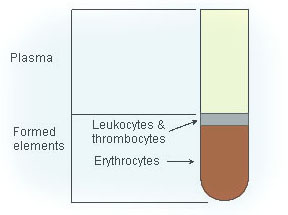
When a blood sample is placed in a centrifuge, the cellular components separate from the liquid portion of the blood. The formed elements are denser than the fluid matrix and they settle to the bottom of the tube under centrifugal force. The light yellow fluid at the top is plasma, which makes up about 55% of blood volume. The red blood cells form the hematocrit, or packed cell volume (PCV), at the bottom of the tube. Between these layers is a thin whitish band called the buffy coat, which contains white blood cells and platelets.
| Definitions | |
|---|---|
| Plasma |
|
| Formed Elements |
|
| Erythrocytes (red blood cells) |
|
| Leukocytes (white blood cells) |
|
Leukocytes
Leukocytes in the blood are divided into two main groups: granulocytes, which contain cytoplasmic granules, and agranulocytes, which lack them.
| Type of Leukocyte | Name | Description |
|---|---|---|
| Agranulocytes | Lymphocytes | Have a special role in the immune process. Some attack bacteria directly; others produce antibodies |
| Agranulocytes | Monocytes | Critical role in the immune system acting as the body’s cleanup crew by engulfing and digesting pathogens, cellular debris and damaged cells |
| Granulocyte | Basophils | Secrete histamine and heparin and have blue granules. Called mast tissues |
| Granulocyte | Eosinophils | Have granules that stain red under the microscope and help counteract the effects of histamine. |
| Granulocyte | Neutrophils | Most numerous leukocytes. They are phagocytic and have light-colored granules. |
Platelets
Platelets, also known as thrombocytes, are not whole cells but rather small fragments derived from very large cells called megakaryocytes. These megakaryocytes originate from hemocytoblasts in the red bone marrow. Platelets become sticky and clump together to form plugs that seal breaks or tears in blood vessels, and they also play a key role in initiating blood clot formation.
Updated: December 2, 2025